
Every organ in the human body can experience real, measurable medical pain when it comes under physical distress.
Consider the heart. The heart is an organ, and when the blood supply to its muscle wall gets restricted, that agonising chest pressure is immediately recognised as a serious medical condition – angina, or what is popularly known as a heart attack. Consider the head. When the sensitive blood vessels and nerve pathways surrounding the brain contract under intense stress, we don’t question the suffering – we call it a migraine and treat it as a legitimate health issue. Across the entire human body, we accept a simple truth: when an organ is in pain, a real medical event is happening.
Yet, there is one major organ where this logic gets completely turned off. That organ is the uterus.
The uterus is one of the most astonishing pieces of biological engineering in existence – a specialised, muscle-lined organ capable of building, sustaining, and expanding to hold an entire developing human life. No other organ in the human body can do what it does.
Yet, when this exact same organ undergoes intense, debilitating pain during periods, the outlook suddenly shifts. Instead of recognising an organ in distress, society routinely dismisses the experience as a minor annoyance, a routine inconvenience, or a simple lack of pain tolerance.
If you have ever doubted whether period pain is a real medical condition, this article will help clear that myth once and for all. And if you already know period pain is real, it will give you the exact scientific and biological reasons behind what your body is actually going through. We are not introducing new theories – we are simply breaking down the hard clinical facts that medicine has documented for years.
Read on for 5 minutes – whether you are here to clear a doubt or reinforce what you know, these facts will change how you look at period pain forever.
In This Article
- Introduction
- Biological Evidence #1: The Uterus Belongs to the Hollow Organ Family
- Biological Evidence #2: Why Hollow Organs Squeeze Harder
- Biological Evidence #3: When Uterus Squeezes Harder
- Biological Evidence #4: Why Period Cramps Are Clinically Uterine Colic
- Conclusion: The Tomato Analogy (Biological Reality vs. Cultural Perception)
- References
Biological Evidence #1: The Uterus Belongs to the Hollow Organ Family
The human body’s major organs fall into two distinct structural categories: solid organs and hollow organs.
Solid organs – such as the liver, brain, or spleen – are dense masses of solid tissue. They do not hold open interior spaces or chambers, and their primary function does not involve moving physical material through themselves.
Hollow organs – such as the stomach, gallbladder, intestines, urinary bladder, and the uterus – are constructed as hollow pouches, tubes, or containers. Their structural job is to hold, process, or transport fluids and solids through the body.
- The stomach holds and processes food.
- The gallbladder holds bile juice.
- The intestines hold and move digesting waste.
- The urinary bladder holds urine.
- The uterus holds a developing embryo, and when pregnancy does not occur, it holds the nutrients built for nurturing an embryo.
Because hollow organs must contain and move physical substances, their walls are made of smooth muscle. When a hollow organ needs to move its contents out or forward, the smooth muscles in its walls contract in a coordinated manner. If the pathway is clear, the contents move out or forward smoothly without you even realising it. For example, when your intestines are working normally, stool moves out easily without discomfort.
When any hollow organ meets any resistance, the smooth muscle responds by increasing its force, resulting in intense, involuntary squeezing.
To understand why this happens, consider how single-minded a hollow organ actually is. Your large intestine, for instance, knows only one job: move its contents forward.
The large intestine doesn’t know whether the obstacle in its path is soft stool, hard waste, or trapped gas. It only knows that something is blocking the exit. So, to accomplish its single job, it does the only thing it is programmed to do – it squeezes harder. This is felt as a sharp pain on the outside.
Biological Evidence #2: Why Hollow Organs Squeeze Harder
Why does a hollow organ squeeze so hard when it meets resistance? You can understand this with a simple everyday experience: The Toothpick Effect.
Imagine getting a tiny piece of food stuck firmly between your teeth. The moment it gets stuck, you instantly feel an relentless urge to get it out. Your tongue won’t stop picking at it, and you immediately reach for a toothpick. You don’t ignore it, because as long as that narrow gap is blocked, the irritation persists.
This is exactly how smooth muscle is programmed to behave.
When a hollow organ senses that its exit is narrow or blocked, it doesn’t wait, adapt, or relax. It treats the blockage as an immediate obstruction that must be cleared. And since a hollow organ has no hands or toothpicks, it uses the only tool it has: it increases its squeezing force.
The harder the obstacle, the harder the organ squeezes. What you experience as an agonising, wave-like cramp is simply a hollow organ persistently picking at the obstacle until the passage is clear.
Biological Evidence #3: When Uterus Squeezes Harder
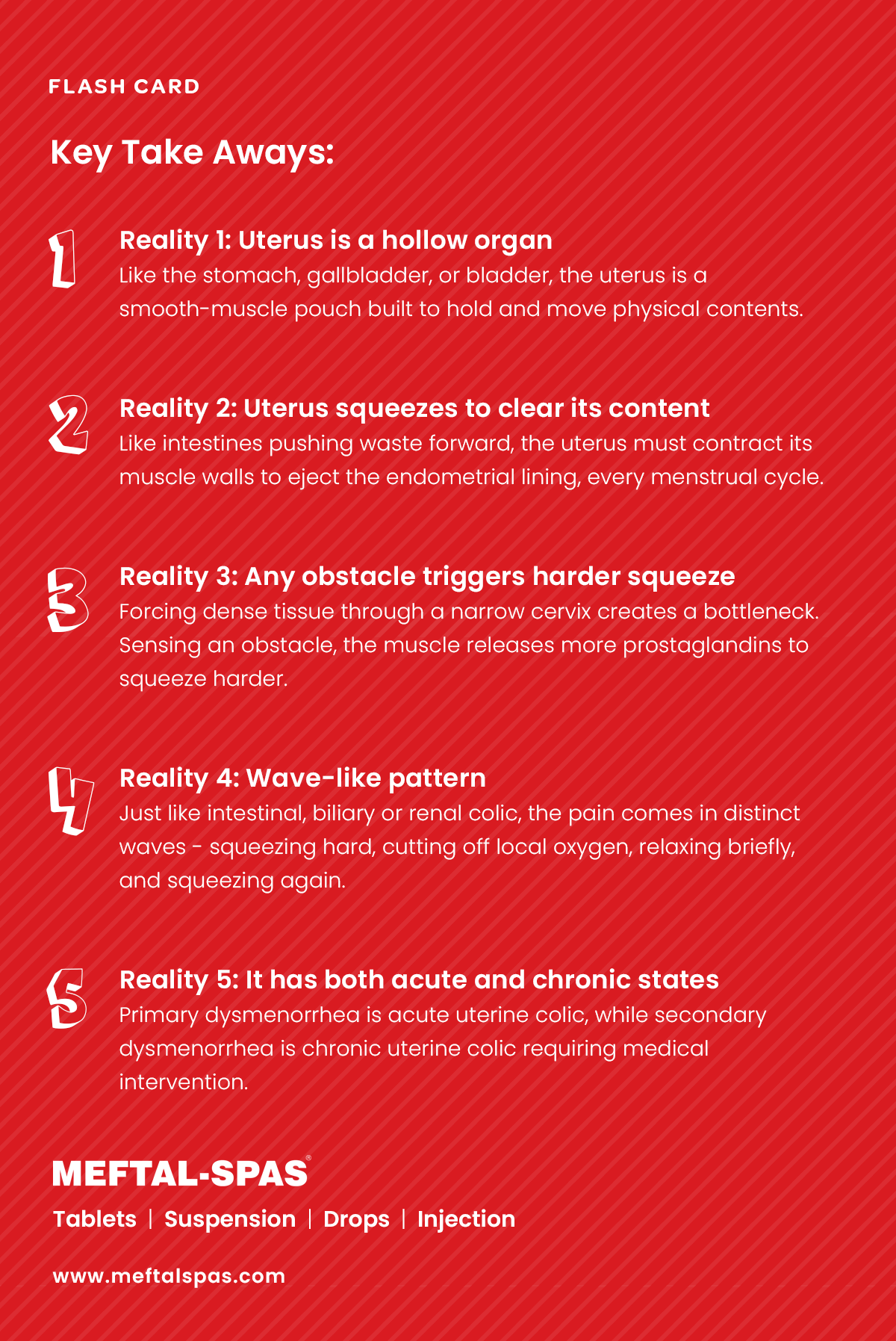
The uterus is also a hollow organ lined with thick, dense smooth muscle called the myometrium. Every menstrual cycle, the uterus prepares for a potential pregnancy by building up a nutrient-rich lining (the endometrial lining) on the inside of this muscle.
To keep it simple, you can think of this lining as fresh, high-quality nutrition prepared specifically for an embryo. If pregnancy doesn’t happen during that menstrual cycle, this lining must be shed and ejected from the uterus. Wondering why? It is the body’s built-in survival mechanism. To give a future embryo the best possible chance of growing healthily, the body refuses to rely on stale nutrition. It clears out the old lining so it can build a completely fresh, nutrient-rich lining for the next menstrual cycle.
Unlike liquid urine from the bladder or soft food in the stomach, the endometrial lining is not a simple fluid – it is a mix of dense tissue clots, blood, and cellular material. And to leave the uterus, all of this material must pass through one extremely narrow exit point: the cervix.
Here is where the uterus differs from every other hollow organ in a human body.
Your stomach and intestines are designed to constantly push contents forward every single day. The uterus, by default, is engineered to do the exact opposite: retain and hold. For nine months during a pregnancy, its muscle walls must stay quiet, relaxed, and secure.
So, how does an organ built for holding suddenly switch into ejection mode?
It uses a chemical trigger called prostaglandins. When pregnancy doesn’t occur, the nutrient-rich-lining releases prostaglandins directly into the uterine muscle. Prostaglandins act as the switch – they command the smooth muscle of the uterus to flip and start squeezing. From here, the mechanism works exactly the same as any other hollow organ:
- The Bottleneck: The thick, clotted lining hits the tight opening of the cervix.
- The Resistance: The material cannot instantly pass through this narrow exit, creating a physical blockage.
- The Escalation: The smooth muscle senses the resistance and follows its single-minded programming: it releases even higher levels of prostaglandins to squeeze harder. This is the toothpick effect taking over.
- The Pain: To force the dense tissue through the bottleneck, the uterine muscle contracts with extreme pressure – spiking the pressure inside the uterus extremely high. This force temporarily crushes its own blood vessels, cutting off local oxygen supply, thus resulting in extreme cramping pain.
- The Wave Pattern: The uterus squeezes hard for some time, then it relaxes – during which you feel the pain has subsided. And then it starts squeezing hard again, resulting in classic period cramps.
Biological Evidence #4: Why Period Cramps Are Clinically Uterine Colic
When any other hollow organ experiences an involuntary smooth-muscle spasm against an obstacle, medicine calls it colic:
- Renal Colic: Smooth muscle squeezing against a kidney stone.
- Biliary Colic: Smooth muscle squeezing against a gallstone.
- Intestinal Colic: Smooth muscle squeezing against trapped waste or gas.
In all three cases, doctors treat the event as legitimate, acute medical pain.
Yet, when the exact same smooth-muscle spasm happens inside the uterus – forcing thick tissue through the narrow cervix – the medical label changes. Instead of calling it uterine colic, it gets labeled as dysmenorrhea, and casually dismissed in daily life as just period cramps.
When medicine treats other colics as a clinical emergency but rebrands the exact same muscular force in the uterus as a routine inconvenience, it creates a cultural permission to dismiss real physiological distress.
Conclusion: The Tomato Analogy (Biological Reality vs. Cultural Perception)
In science, definitions are precise: for something to be a fruit, it simply must be the seed-bearing structure produced by a flowering plant. Under this rule, a tomato is undeniably a fruit. Yet, in everyday life, we treat it, store it, and cook it as a vegetable. Social habits have completely overruled biological reality.
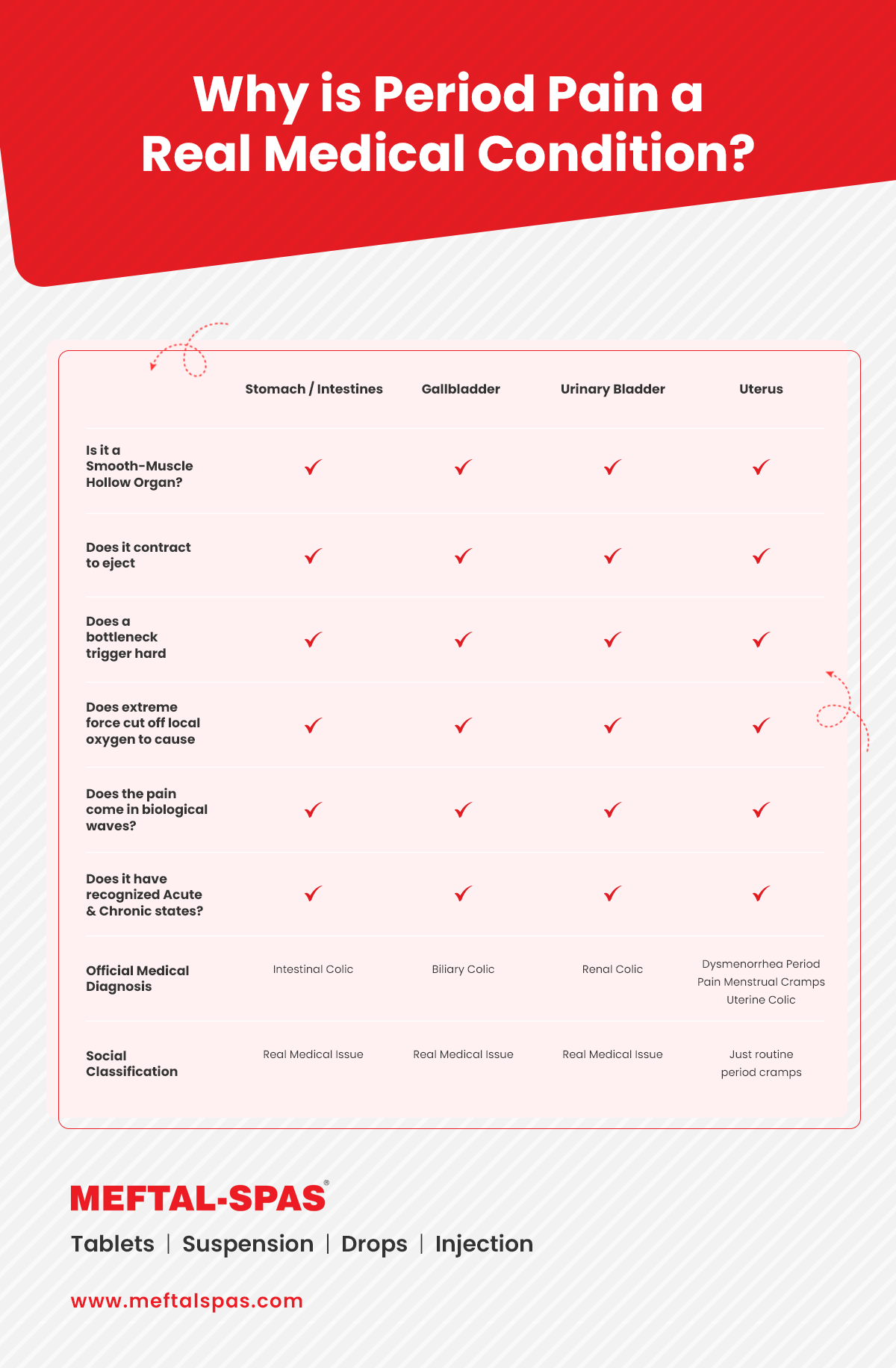
Unfortunately, the exact same thing has happened to period pain. Period pain satisfies every single physical criterion of hollow-organ disease:
- A Smooth-Muscle Hollow Organ: Built like the stomach, gallbladder, and bladder.
- A Physical Obstacle: Thick tissue forcing its way through a tiny cervical exit.
- Escalating Squeezing Force: The Toothpick Effect driving high-pressure spasms.
- Ischemia: Pressure spiking high enough to crush local blood vessels, cutting off oxygen and firing acute pain receptors.
If these four conditions occur in the kidneys, gallbladder, or gut, medicine calls it colic and treats it as an urgent, physical event. But when they happen inside the uterus, social usage steps in – just like it did with the tomato – and reclassifies a clear medical pain as ‘just routine period cramps’.
Period pain is not a mindset, a low threshold for discomfort, or an emotional overreaction. Period pain is uterine colic – a biological reality that stands firmly on first-principles anatomy, no matter how society chooses to classify it.
More Stories To Read
Transform your understanding of colic through engaging and informative stories based on real medical insights.
The Answers You've Been Looking For
Get clear, concise answers to your most pressing questions about colic.
Disclaimer
This content is for informational purposes only and is not a substitute for professional medical advice. The information provided here is based on general trends and may not apply to every individual, as every person’s body and experience with colic is unique.