

The distinction between acute colic and chronic colic is one of the most misunderstood concepts in health – and internet search results only make it worse.
If you search online, most articles leave you with a simple, inaccurate takeaway: acute colic is a sudden, excruciating emergency, while chronic colic is a milder, long-term ache.
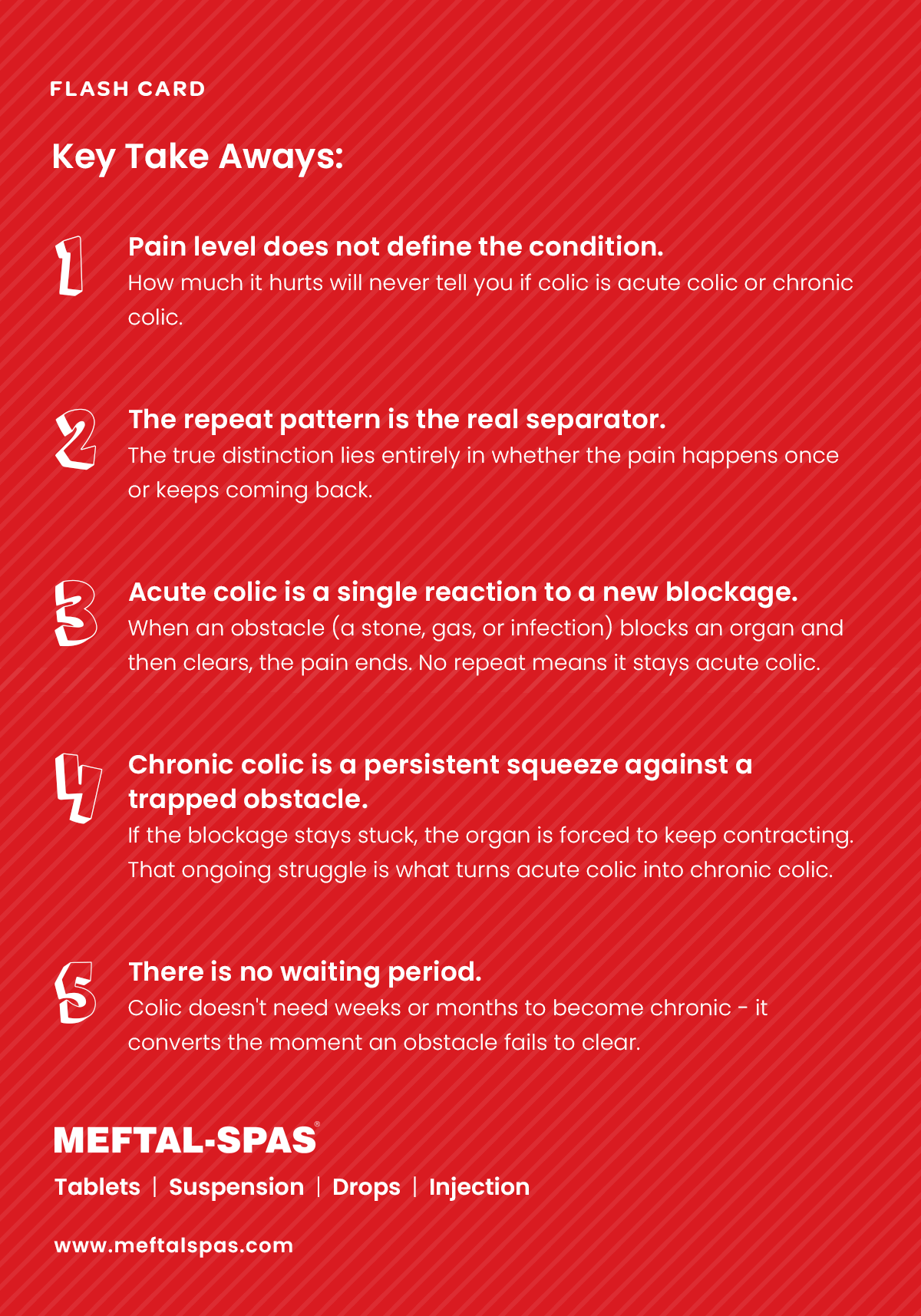
This is where standard medical content fails the reader. It confuses how bad a single attack feels with how frequently the same problem reappears.
Here is the reality:
- Acute does not simply mean ‘unbearable emergency’. An acute colic episode can sometimes be brief and mild enough to pass on its own with a warm compress or a simple painkiller.
- Chronic does not mean ‘mild or manageable’. A chronic colic flare-up can be so violently painful that the person is unable to calm down in any position and ends up visiting the doctor or a hospital emergency room.
The true difference between acute and chronic colic is never about how much it hurts in the moment. It comes down to a simple question about the root cause:
Did the root cause resolve, or is it still sitting there, waiting to trigger the exact same pain again?
In This Article
- Introduction
- A Quick Recap on What Colic Actually Is
- Understanding Acute Colic vs. Chronic Colic with a Real Example
- Acute Colic is a Sudden Siege Against a New Obstacle
- Chronic Colic is What Happens When the Obstacle Doesn’t Get Removed
- Conclusion: How Doctors Use Acute Colic and Chronic Colic Distinction to Guide Your Care
- References
A Quick Recap on What Colic Actually Is
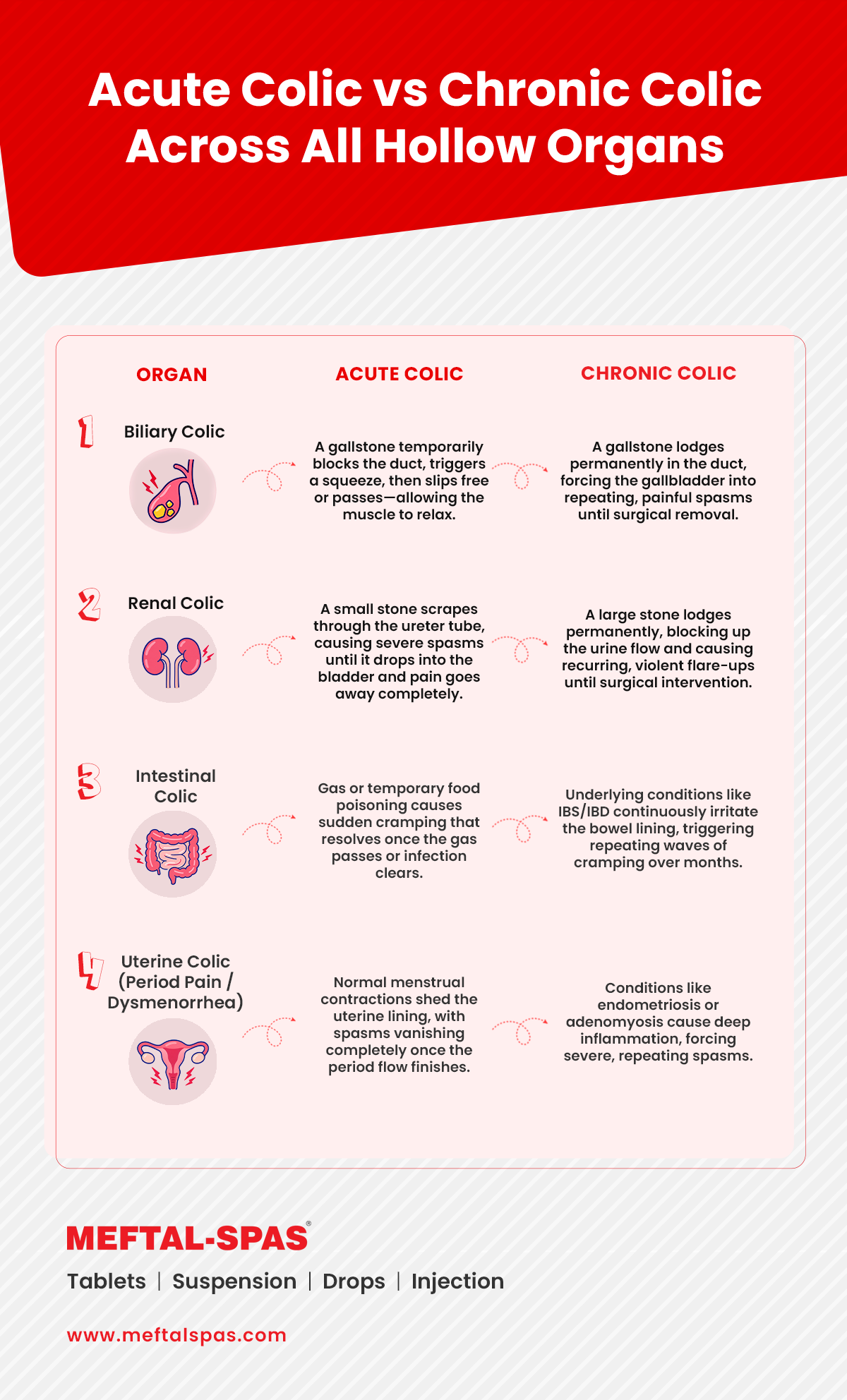
Colic is a specific type of pain that occurs exclusively in hollow organs – organs shaped like tubes or pouches, such as your stomach, intestines, gallbladder, kidneys, or uterus.
These organs are internally lined with smooth muscle and designed to hold or move substances through your body. For instance, your gallbladder holds bile fluid, while your intestines push food forward.
When an obstacle blocks one of these organ pathways or irritates its inner smooth muscle lining, the muscle squeezes hard to remove the obstacle. That obstacle can be several things – for example, gallstones, which are tiny, hardened masses of cholesterol that form inside the gallbladder. When the gallbladder contracts to release bile after a meal, it can force one of these stones straight into its narrow exit passage, thus blocking it, and triggering a massive squeeze.
Now that we understand how colic works, let’s look at a real-life scenario to see how acute colic differs from chronic colic.
Understanding Acute Colic vs. Chronic Colic with a Real Example
Anand Kumar, a 62-year-old living in Mumbai, had spent his entire life without a single day of stomach trouble.
Then, late one evening after a heavy dinner, an intense pain struck his upper right stomach. A warm compress did nothing. His family rushed him to a nearby clinic, where the doctor administered medication that dulled the worst of the agony. But the relief was only partial as a deep, uncomfortable pressure lingered over the next two to three days. A subsequent ultrasound scan revealed the culprit: tiny gallstones trapped in the narrow neck of his gallbladder.
So, was Anand’s pain acute colic or chronic colic? The answer is that it started as one, and quickly became the other.
Acute Colic is a Sudden Squeeze Against a New Obstacle
The very first moment that the gallstone shifted and blocked the exit passage (the bile duct), Anand’s gallbladder reacted. Its smooth muscle walls squeezed with violent force to remove the gallstone. That initial, out-of-nowhere pain was an acute colic episode – a sudden, isolated reaction to a brand-new obstacle.
If that stone had simply slipped back into the gallbladder or passed through into the intestine, the path would have been cleared. The gallbladder’s muscle would have relaxed, the inflammation would have settled, and Anand’s life would have gone right back to normal. That would have been the end of an isolated, acute colic event.
Chronic Colic is What Happens When The Obstacle Doesn’t Get Removed
But in Anand’s case, the gallstone stayed stuck.
Because the obstacle never cleared, Anand’s gallbladder was forced to keep pushing against the gallstone day after day. The pain wasn’t vanishing because the root cause was still sitting right there. That initial acute colic attack had now officially crossed over into chronic colic – a repeating, long-term trap.
In Anand’s case, medication temporarily calmed the active muscle spasm, but it couldn’t remove the trapped gallstone. The only way to stop the next excruciating pain was surgery to remove the gallbladder altogether. Surgery didn’t just cure a single bad evening – it broke a chronic cycle before the next violent flare-up could strike.
Conclusion: How Doctors Use Acute Colic and Chronic Colic Distinction To Guide Your Care
The line between acute and chronic colic isn’t just medical theory – it directly dictates how your doctor treats you.
When you first visit a clinic with colic pain, a doctor’s immediate priority is to break the active muscle spasm and calm the tissue. They will almost always prescribe a combination of an antispasmodic (to stop the muscle wall from violently squeezing) and an anti-inflammatory (to bring down local swelling).
What happens next determines your entire medical path:
- If the pain vanishes and never returns: The treatment worked, the obstacle cleared, and your case remains logged as an isolated, acute colic event. No further action is needed.
- If you return to the clinic with repeating pain: The doctor immediately recognises that the obstacle is still sitting there. Your diagnosis shifts from acute to chronic colic, triggering the next phase of care: diagnostic imaging (like ultrasounds or CT scans) and an immediate
referral to a specialist.
Depending on which organ is trapped in that loop, you will be directed to the right expert:
- A gastroenterologist for intestinal or biliary colic
- A Urologist for kidney colic
- A Gynecologist for uterine colic.
Understanding this distinction between acute colic and chronic colic empowers you as a patient. If the pain comes back after your medication runs out, don’t just ask for a stronger painkiller – tell your doctor the pattern is repeating so they can jump straight to finding and removing the root obstacle.
The Answers You've Been Looking For
Get clear, concise answers to your most pressing questions about colic.
Disclaimer
This content is for informational purposes only and is not a substitute for professional medical advice. The information provided here is based on general trends and may not apply to every individual, as every person’s body and experience with colic is unique.