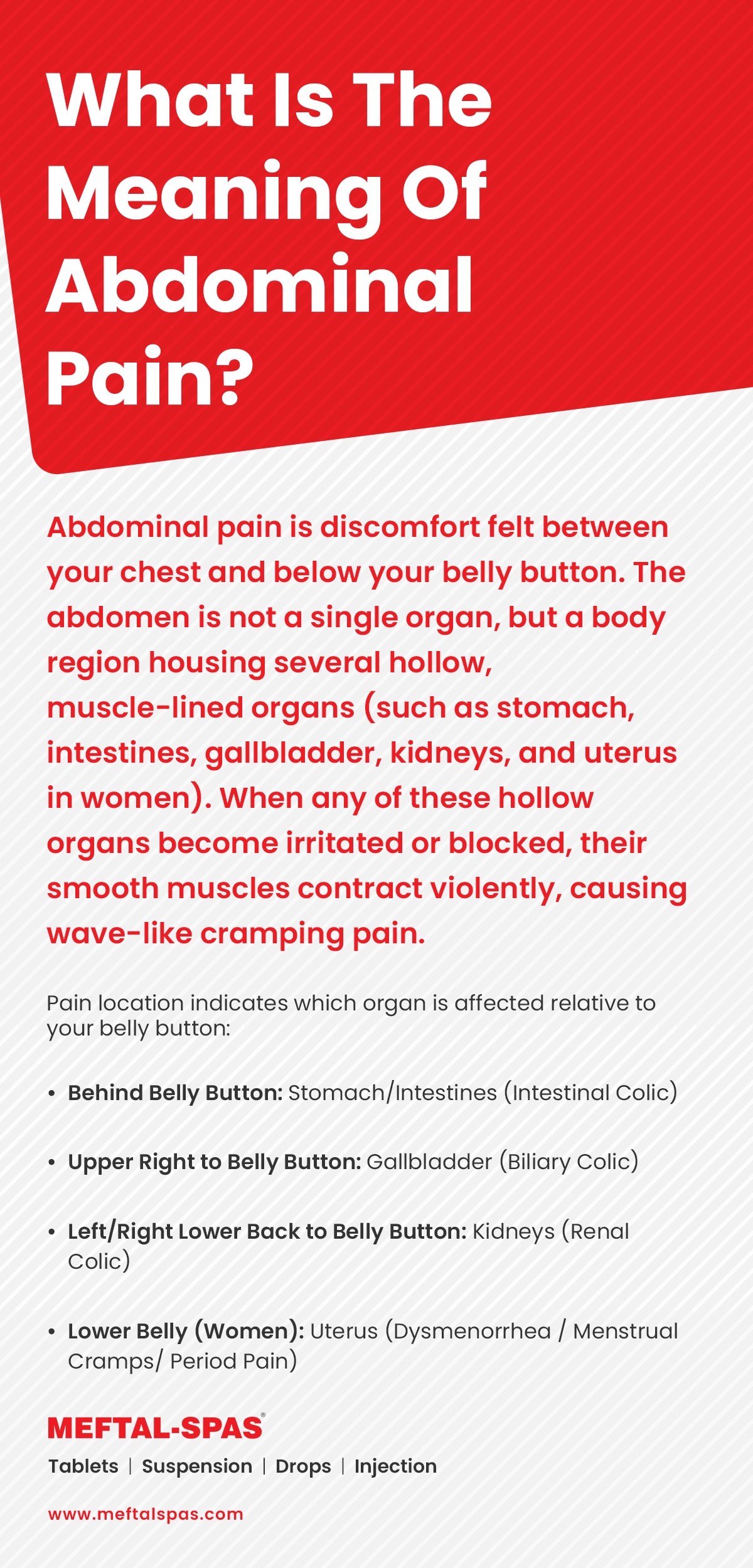
Abdominal pain refers to any uncomfortable feeling – whether it is a continuous dull ache or a sharp cramping pain – felt in the area from just below your chest down to below your belly button. It is important to understand that the abdomen is not a single organ, but a body region housing several major organs, including your stomach, intestines, gallbladder, kidneys, and uterus (in women).
All these organs share a key feature: they are hollow organs lined with smooth muscles. When the muscle walls of any of these hollow organs become inflamed, irritated, or blocked, they respond by contracting violently. This causes a sharp cramping pain that comes in waves – meaning it intensifies, eases slightly, and then intensifies again—a specific pattern of pain known as colic.
How Location Explains Your Abdominal Pain
What your abdominal pain means depends on which specific organ is affected, which you can easily identify based on where the pain occurs relative to your belly button:
Pain Around or Behind the Belly Button
- Organs affected: Stomach and intestinal tract.
- Condition name: Intestinal Colic (or stomach spasms)
Pain in the Upper Right Side, Above the Belly Button
- Organs affected: Gallbladder (located just under your ribs on the right).
- Condition name: Biliary Colic (pain caused by gallstones).
Left Side & Right Side of the Lower Back/Waist
- Organs affected: Kidneys and urinary tubes (located toward your back on either side).
- Condition name: Renal Colic (kidney stone pain).
Lower Belly, Below the Belly Button (Only in Women)
- Organs affected: Uterus (located in the lower center of the belly).
- Condition name: Dysmenorrhea (often referred to as period pain or menstrual cramps).
How is Abdominal Pain Treated?
For acute abdominal pain (sudden, intense, and temporary pain), treatment focuses on fast, targeted relief. Regardless of which organ is affected, acute abdominal pain always involves two underlying issues: inflammation and a squeezing muscle.
Because of this dual mechanism, the first preferred line of treatment is a combination of an NSAID and an anti-spasmodic drug:
- NSAID: Reduces swelling and inflammation inside the affected organ.
- Anti-Spasmodic: Relaxes the squeezing muscles to stop the painful contractions.